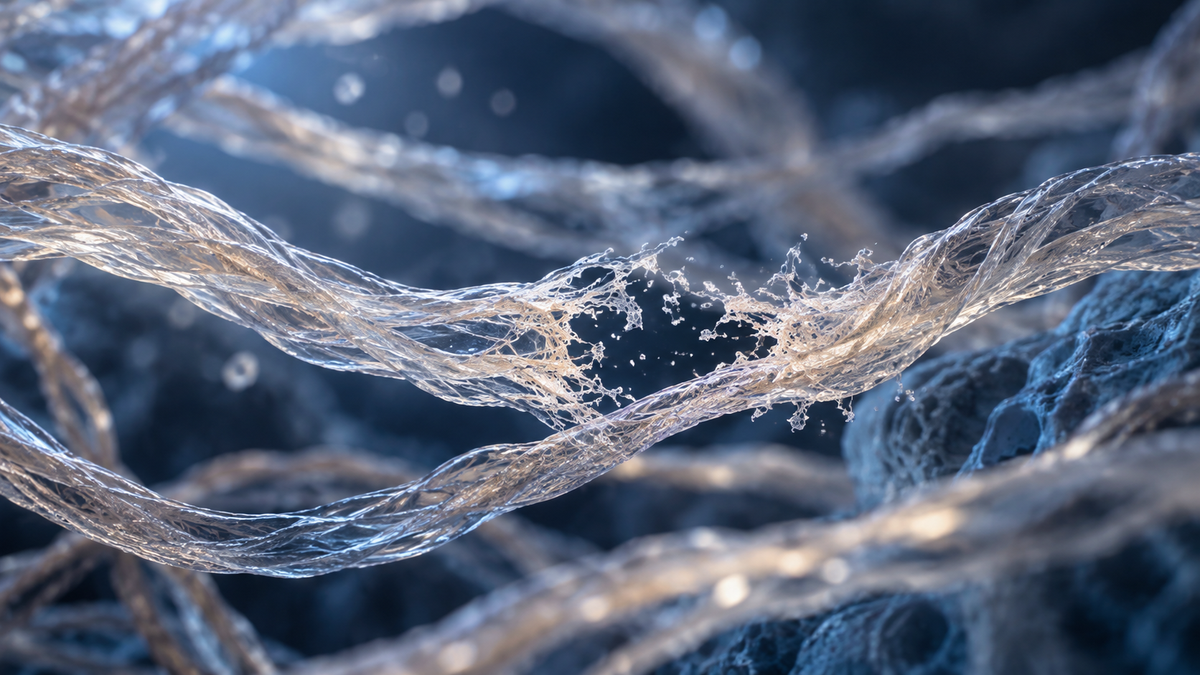
Collagen is continually maintained and remodeled. MMP-1 is one of the enzymes involved, making it a useful entry point for understanding photoaging. Follow the biology from environmental exposure to tissue change, then see where different interventions fit.
In this guide
- MMP-1 is part of normal matrix biology
- UV exposure is a major upstream trigger
- Why collagen fragmentation matters
- MMP-1 is not the only MMP
- The intervention with direct prevention evidence
- Where NAD+ enters the discussion
- Where quercetin and resveratrol enter the discussion
- FAQ
- Related PAG LABS research
- Make the next step a considered one
- Keep the comparison clear
MMP-1 is part of normal matrix biology
MMP-1 is an interstitial collagenase. Matrix metalloproteinases help remodel extracellular matrix during normal physiology, including repair. The issue in photoaging is not that MMP-1 exists; it is that repeated environmental signaling can shift matrix turnover toward chronic fragmentation and impaired organization.
UV exposure is a major upstream trigger
Human skin research has long identified solar UV radiation as the major environmental cause of photoaging. UV-driven signaling can increase transcription factors and matrix metalloproteinases, contributing to collagen fragmentation.
Review: Mechanisms of photoaging and chronological skin aging.
A human study also directly linked UV-induced DNA damage with MMP-1 release.
Primary reference: UV-induced DNA damage initiates release of MMP-1 in human skin.
Why collagen fragmentation matters
Dermal fibroblasts interact mechanically with the surrounding extracellular matrix. When collagen architecture becomes fragmented, fibroblast function and matrix homeostasis can change. Photoaging therefore involves a feedback loop between environmental damage, signaling and tissue structure rather than a single enzyme acting alone.
For the time-course question, see How Long Does Skin Collagen Remodeling Take?.
MMP-1 is not the only MMP
Photoaging involves a broader network of matrix metalloproteinases and inhibitors, inflammatory mediators, reactive oxygen species, growth-factor signaling and changes in collagen synthesis. Focusing on MMP-1 is useful for education but incomplete as a model of skin aging.
The intervention with direct prevention evidence
If UV is an important upstream driver, reducing excessive UV exposure is a direct way to lower that environmental pressure. A randomized trial found less measured skin aging with regular sunscreen use over 4.5 years.
See How to Reduce Wrinkles Naturally for the broader intervention hierarchy.
Where NAD+ enters the discussion
NAD+ and sirtuin biology intersect with cellular stress-response pathways, which creates mechanistic reasons to study them in aging. But no cited evidence here establishes that PAG NAD CORE's 500 mg direct NAD+ dose suppresses MMP-1 in human facial skin.
The distinction between pathway relevance and direct oral evidence is covered in NAD+ for Skin.
Where quercetin and resveratrol enter the discussion
Polyphenols can influence oxidative and inflammatory signaling in experimental systems. Again, a pathway effect in cells is not automatically a clinical outcome after oral supplementation. Dose, bioavailability and tissue exposure matter.
FAQ
What is MMP-1?
MMP-1 is a matrix metalloproteinase capable of cleaving fibrillar collagen. It participates in normal tissue remodeling as well as UV-related photoaging pathways.
Does UV increase MMP-1 in human skin?
Human experimental research supports UV-induced signaling and MMP-1 release as part of photoaging biology.
Can you stop skin aging by blocking MMP-1?
No single-enzyme explanation is sufficient. Photoaging involves UV exposure, multiple MMPs, oxidative and inflammatory signaling, collagen synthesis, pigmentation and other processes.
Does PAG NAD CORE clinically suppress MMP-1?
No such finished-product clinical claim is established. NAD+, quercetin and resveratrol have mechanistic reasons for research interest, but that is not the same as demonstrating MMP-1 suppression after the labeled oral doses.
Related PAG LABS research
- MMP-1 and Skin Aging: shorter overview
- The 500 Dalton Rule: How to Think Beyond the Surface
- Topical vs Oral Skin Aging Interventions
- PAG LABS Research Library
Make the next step a considered one
If a clearly labeled supplement fits your approach, explore PAG NAD CORE: direct NAD+, quercetin and a standardized resveratrol source, organized as a simple daily routine. Review the ingredient forms and research alongside the practices you already use.
Explore the formula: PAG NAD CORE — ingredients, serving size and the 90-day protocol.
Published by PAG LABS, the brand behind PAG NAD CORE. Updated September 13, 2026.
Keep the comparison clear

For the wider context, explore the research table and our guide to comparing supplement labels.