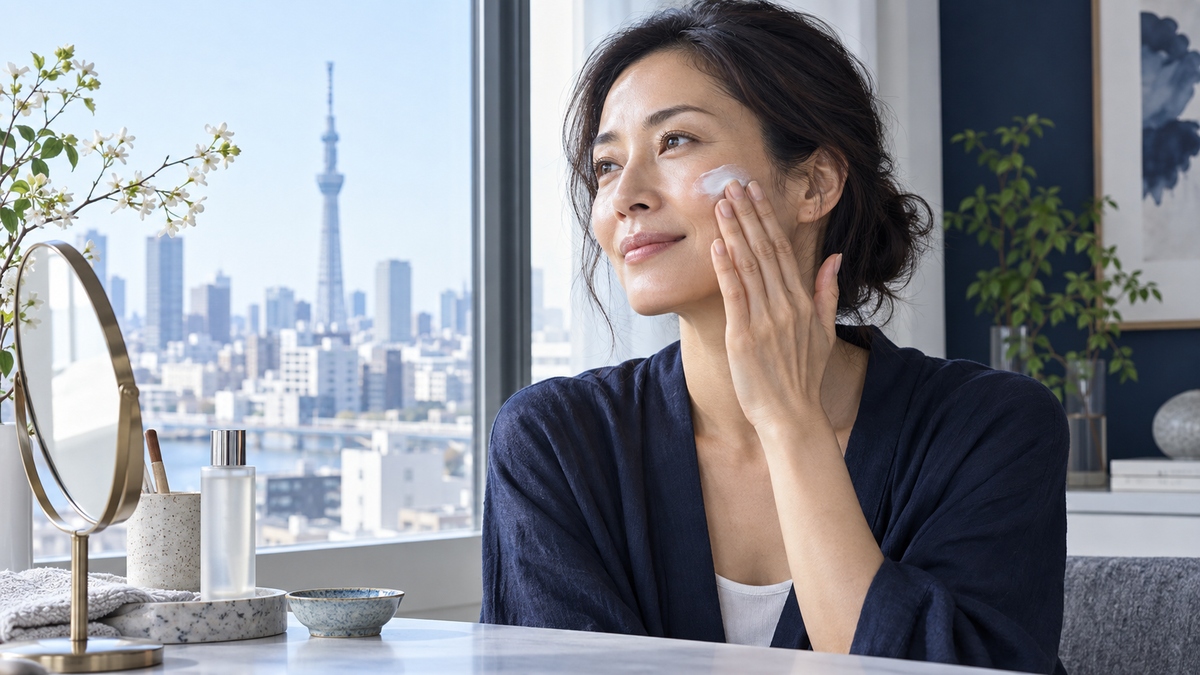
The most useful question in Japanese-inspired skincare is what you can practice consistently. Prevention, barrier care and carefully chosen treatments give you a clear structure. The value comes from the action and its evidence, with room for individual preferences and skin needs.
In this guide
- Prevention: cumulative UV exposure is a major target
- Barrier care: comfort and hydration
- Correction: retinoids have real evidence
- Procedures can target outcomes that skincare cannot
- Where nutrition and supplements fit
- A better long-term framework
- PAG LABS perspective
- FAQ
- Related PAG LABS research
- Make the next step a considered one
- Keep the comparison clear
Prevention: cumulative UV exposure is a major target
Photoaging accumulates over time and depends strongly on UV exposure and skin pigmentation. A classic review by Fisher and colleagues describes UV irradiation as the primary environmental factor driving human skin aging.
Reference: Mechanisms of photoaging and chronological skin aging.
More importantly, randomized evidence shows that regular sunscreen use can slow measured skin aging.
Barrier care: comfort and hydration
Moisturizers can reduce dryness, improve barrier function and make fine lines less visible. These effects matter. Preventive care does not need to invoke NAD+, senescence or collagen remodeling to be worthwhile. The 500 Dalton rule guide explains why surface effects can still be legitimate clinical or cosmetic benefits.
Correction: retinoids have real evidence
Topical tretinoin has randomized-trial evidence for multiple signs of photoaging. That is correction, but it also influences ongoing epidermal and dermal biology. The simplistic idea that corrective skincare merely “covers damage” is inaccurate.
Systematic review of topical tretinoin randomized trials.
Procedures can target outcomes that skincare cannot
Laser resurfacing, chemical peels, neuromodulators and fillers address different features and carry different risks. They should be evaluated separately and performed by qualified professionals when appropriate. Their existence does not prove prevention failed; aging is continuous and no preventive routine stops it entirely.
Where nutrition and supplements fit
Dietary patterns influence general health, and some oral interventions have skin-related research. But supplements should not be used to create a false choice between “inside-out biology” and topical care. Oral delivery has its own absorption and tissue-distribution limitations. See Topical vs Oral Skin Aging Interventions.
A better long-term framework
- Prevent avoidable damage: photoprotection and smoking avoidance.
- Maintain barrier function: gentle cleansing and appropriate moisturization.
- Use validated actives when appropriate: retinoids are a leading example.
- Treat specific concerns specifically: pigmentation, acne, rosacea and structural aging are different problems.
- Consider nutrition and supplements as adjuncts: judge each by direct evidence and safety.
PAG LABS perspective
Build your routine in layers: daily photoprotection, skincare suited to your skin, and informed choices about nutrition. PAG NAD CORE fits into the dietary-supplement part of that routine.
FAQ
Is preventive skincare better than corrective skincare?
They answer different needs. Prevention reduces avoidable future damage; correction addresses changes that are already present. A strong long-term strategy can use both.
Is “Asian skincare” more preventive?
Some routines and markets may emphasize prevention, but that is a cultural and commercial observation, not a biological rule. Practices vary widely within every region.
Can supplements replace sunscreen or retinoids?
Current evidence does not support treating supplements as replacements for interventions with direct human photoaging data.
What should come first for skin longevity?
Reducing avoidable UV exposure and smoking are foundational. Barrier care and evidence-based treatments can then be matched to the individual's concerns and tolerance.
Related PAG LABS research
Make the next step a considered one
If a clearly labeled supplement fits your approach, explore PAG NAD CORE: direct NAD+, quercetin and a standardized resveratrol source, organized as a simple daily routine. Review the ingredient forms and research alongside the practices you already use.
Explore the formula: PAG NAD CORE — ingredients, serving size and the 90-day protocol.
Continue reading: Korean skincare vs skin longevity: where NAD+ fits
Published by PAG LABS, the brand behind PAG NAD CORE. Updated September 13, 2026.
Keep the comparison clear

For the wider context, explore the research table and our guide to comparing supplement labels.