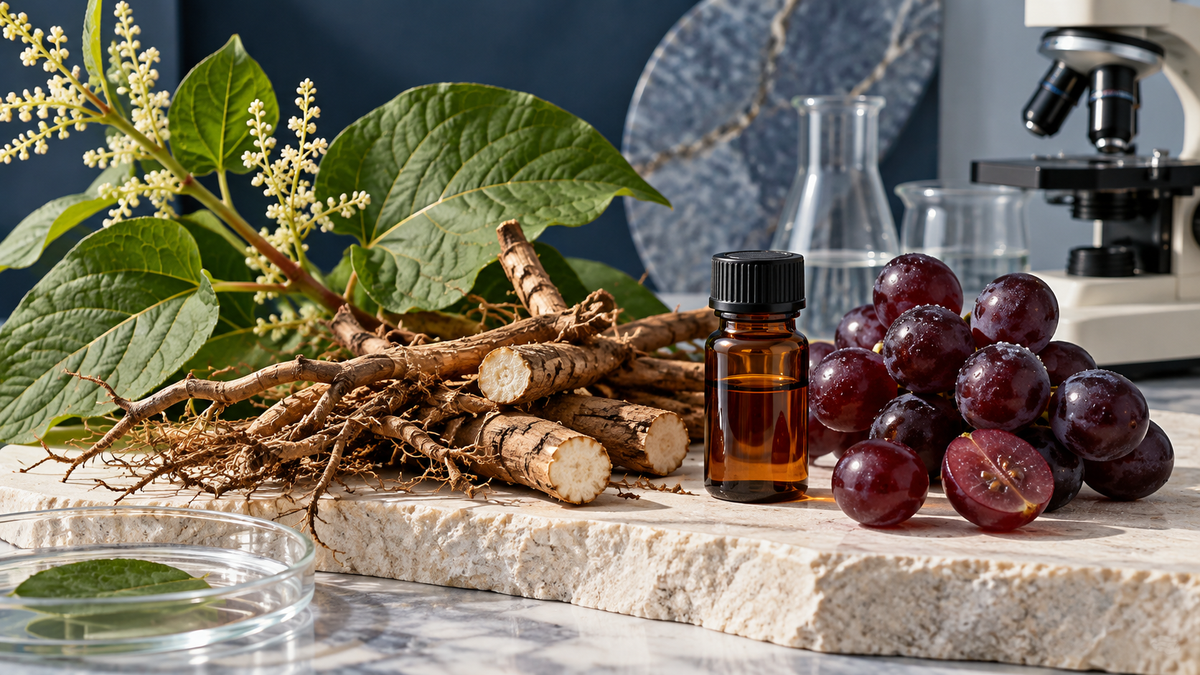
Resveratrol brings plant-polyphenol research into the skin-longevity conversation. Understanding its source, formulation and research context helps you compare products with more confidence.
In this guide
Why it attracts scientific attention
A systematic review of 41 studies described promising work on resveratrol in skin aging, healing and scarring. Antioxidant, inflammatory and cell-protection pathways were central to the discussion. The authors also called for further research to confirm the effects. Hecker et al., 2022.
That is a reason to take the research seriously and read its methods. The literature covers different models and routes, so a topical or laboratory finding should not be presented as a demonstrated benefit of an oral capsule. Direct evidence for oral wrinkle outcomes remains limited.
Start with the extract, then read the percentage
PAG NAD CORE lists 150 mg Japanese knotweed extract standardized to 98% resveratrol per two-capsule serving. The source is Polygonum cuspidatum root.
The extract amount and the percentage describe different things. “150 mg extract” is not the same label statement as “150 mg pure resveratrol.” At 98% standardization, the nominal resveratrol amount is 147 mg. This calculation describes the label specification; it is not an independent batch-analysis result.
What does “Japanese knotweed” tell you?
It identifies the botanical source. It does not establish that the product was grown in Japan or explain population differences in skin aging. For that separate topic, read the Japanese skin-aging studies.
Why pair it with NAD+ and quercetin?
PAG LABS brings these ingredients together around its interest in cellular biology and polyphenols. The selection gives the formula a defined focus and keeps the ingredient list easy to inspect. Complementary research interests are the rationale for the combination; a combined clinical benefit still requires testing of the combination.
Explore the NAD+ guide and the quercetin guide to understand each ingredient separately.
A clear comparison checklist
- Source: what plant or ingredient is named?
- Amount: is the number for the extract or the isolated compound?
- Standardization: what percentage is specified?
- Research: did it test the same route and outcome?
- Routine: how many capsules make a daily serving?
Questions about the formula
Does the label specify trans-resveratrol?
The current label specifies resveratrol standardization without naming an isomer. We keep the description aligned with that label.
Can resveratrol replace sun protection?
Keep sun protection in your routine. Experimental polyphenol research addresses a different question from established photoprotection.
How much is in a full protocol?
Each daily serving includes 150 mg of the standardized extract. Three bottles provide 90 daily servings, taken according to the label.
Explore the formula: PAG NAD CORE — ingredients, serving size and the 90-day protocol.
Published by PAG LABS, the brand behind PAG NAD CORE. Updated September 13, 2026.
Keep the comparison clear

For the wider context, explore the research table and our guide to comparing supplement labels.